

Understanding infrared technology: thermal imaging, night vision and lasers
When you start exploring modern observation equipment—binoculars, scopes and monoculars—one term appears again and again: infrared.
Yet this single word covers very different technologies that are often confused, sometimes poorly explained, and occasionally blurred by marketing.
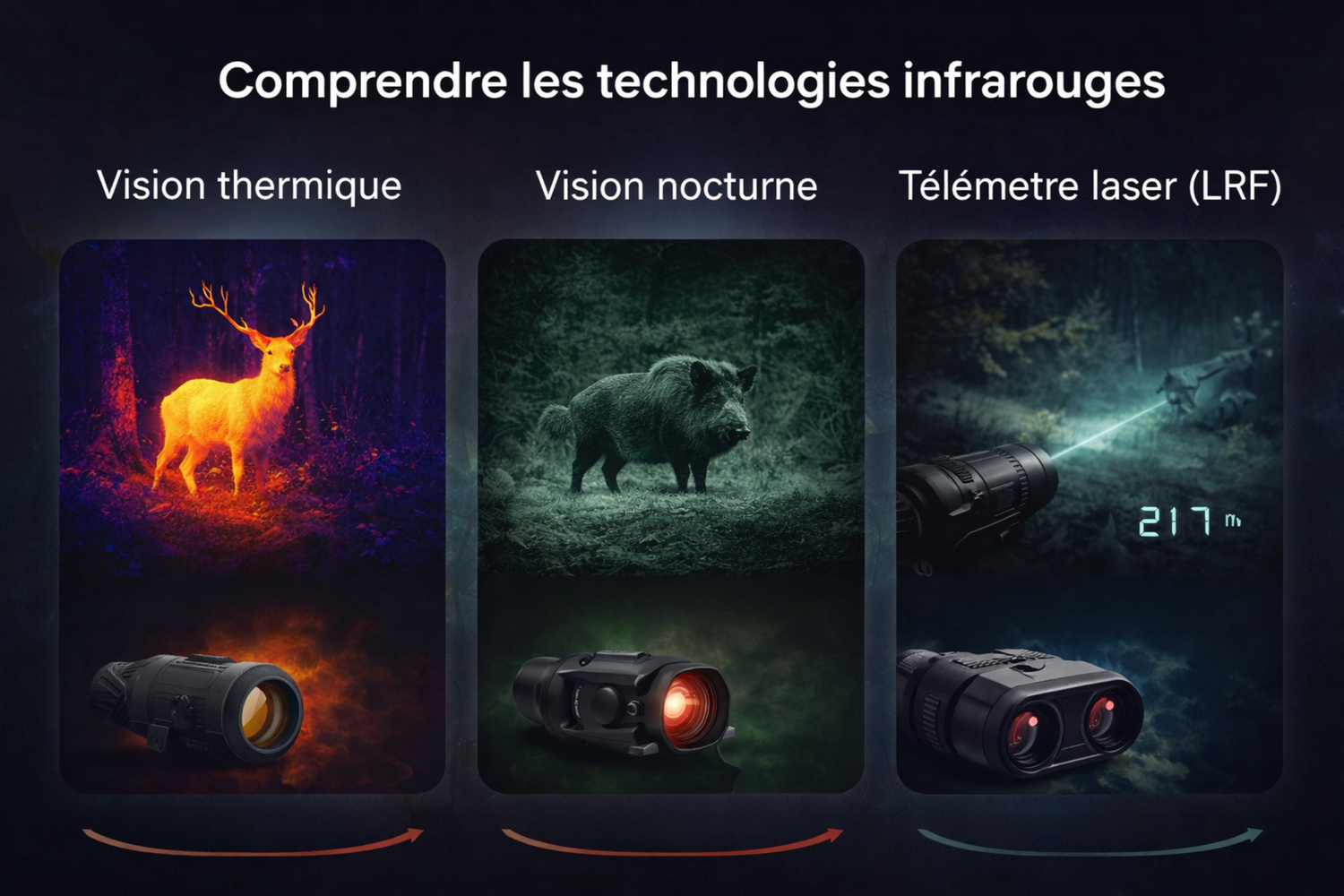
The aim of this guide is to make the differences between thermal imaging, night vision and laser rangefinding (LRF) clear, so you understand what each technology actually does and how it helps in the field.
1. Infrared: one word, several different technologies
The most common mistake is to assume that everything infrared works in the same way. It does not.
Infrared covers a broad part of the electromagnetic spectrum that is invisible to the human eye and divided into distinct bands. The technology, operating principle and resulting image depend on the band being used.
The main distinctions are:
- Long-wave infrared, used in thermal imaging;
- Near-infrared, used in night vision;
- Lasers, used to measure distance.
2. Thermal imaging: seeing heat, not visible light
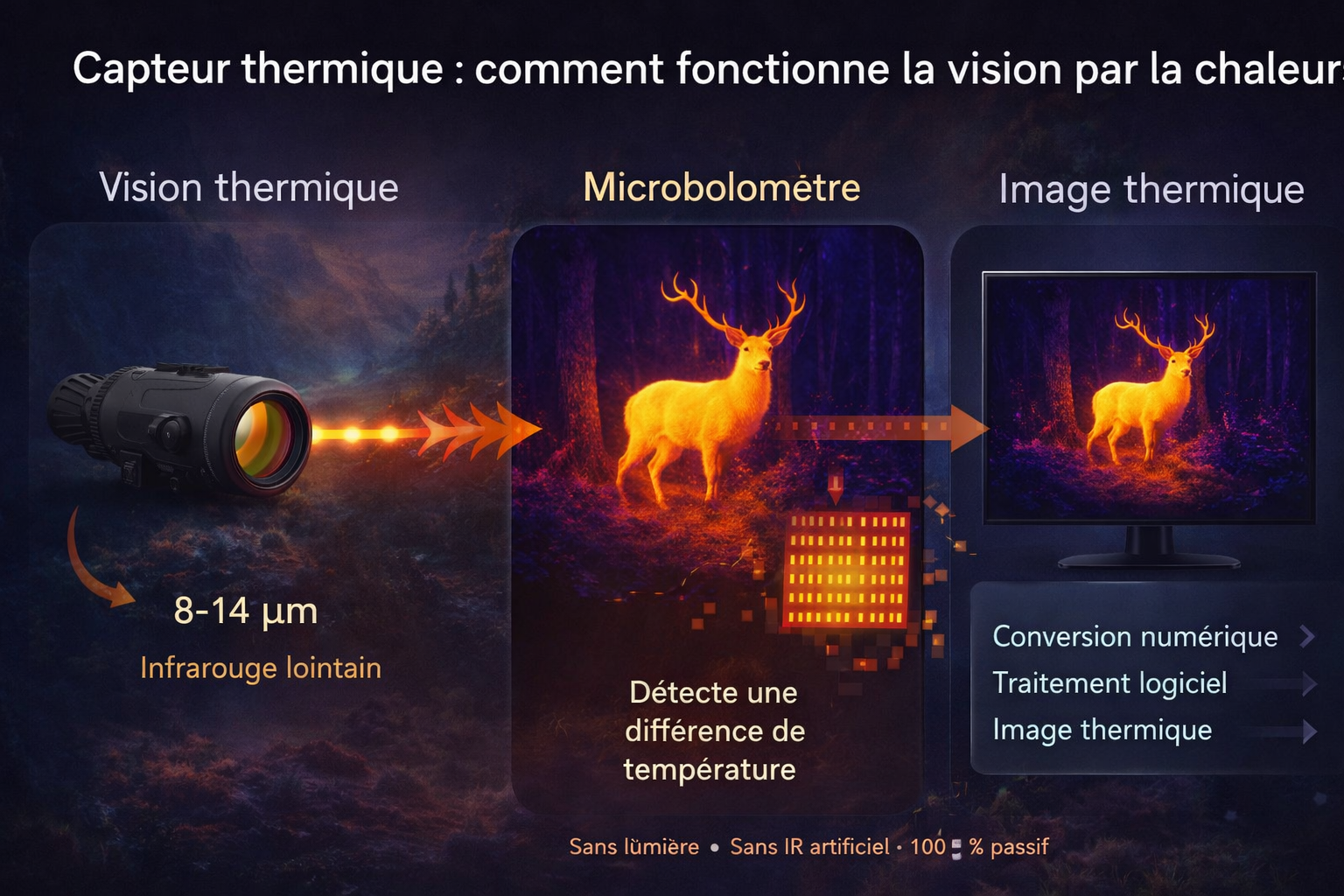
Thermal imaging uses long-wave infrared, also known as LWIR.
How does it work?
A thermal sensor does not capture visible light. It detects differences in thermal radiation naturally emitted by objects, animals and people.
Every living being emits heat. The sensor converts these thermal variations into a high-contrast image.
👉 The result is a visible silhouette even in complete darkness, without moonlight, starlight or artificial lighting.
Key points
- No illuminator required;
- Fully passive operation;
- Effective in light fog, light rain and where vegetation does not fully conceal the subject;
- Ideal for detection.
Limitations
- A less realistic image;
- Fine details can be difficult to identify;
- Heat alone does not always tell you exactly what you are looking at.
3. Night vision: amplifying available light
Night vision works on a completely different principle. It uses near-infrared (NIR), which lies close to the visible spectrum.
How does it work?
The sensor captures weak ambient light from the moon and stars, and/or artificial infrared light emitted by an IR illuminator. This light is then amplified and displayed as an image.
Two common wavelengths
- 850 nm: longer range, with a faint visible red glow;
- 940 nm: invisible illumination, with a shorter range.
Advantages
- A more natural-looking image;
- Excellent identification of species, posture and details;
- Very precise at medium distances.
Limitations
- Depends on natural light or IR illumination;
- Less effective in fog or rain;
- Less capable than thermal imaging for initial detection.
4. Laser rangefinding: measuring, not observing
An LRF (Laser Range Finder) is not an imaging technology. It does not produce a view of the scene.
What is it for?
A laser rangefinder measures the distance between the user and a target accurately. It sends a laser pulse towards the object and calculates the return time.
Why does it matter?
- Shooting safety;
- Ballistic accuracy;
- Reliable distance assessment, especially beyond 150–200 metres.
LRFs are often integrated into thermal binoculars, thermal scopes and night vision scopes.
5. Thermal imaging, night vision and lasers: complementary technologies
These technologies are not mutually exclusive. They address different needs at different times.
| Function | Thermal imaging | Night vision | Laser (LRF) |
|---|---|---|---|
| Detection | ⭐⭐⭐⭐⭐ | ⭐⭐ | ❌ |
| Identification | ⭐⭐ | ⭐⭐⭐⭐⭐ | ❌ |
| Complete darkness | ⭐⭐⭐⭐⭐ | ⭐⭐⭐ | ❌ |
| Poor weather | ⭐⭐⭐⭐ | ⭐ | ❌ |
| Distance measurement | ❌ | ❌ | ⭐⭐⭐⭐⭐ |
This is why equipment combining several technologies is becoming increasingly common.
6. Why these distinctions matter before you buy
Two devices may have the same price, impressive specifications and similar promises, yet deliver radically different results in the field.
Understanding the technology helps you avoid disappointment, choose equipment for your actual use and avoid paying for functions you do not need.
Conclusion
Thermal imaging, night vision and laser rangefinding are three distinct technologies, each designed for a specific purpose:
- Thermal imaging for detection;
- Night vision for identification;
- Laser rangefinding for distance measurement and safer decision-making.
The following articles explore each technology in detail: what really determines performance, what is marketing, and how to choose intelligently for your needs.
🔎 Further reading
- Thermal sensors: how heat-based vision works
- Digital night vision: how do we actually see in the dark?
- LRF: what does a laser rangefinder do in real conditions?

Leave a comment
All comments are moderated before being published.
This site is protected by hCaptcha and the hCaptcha Privacy Policy and Terms of Service apply.