

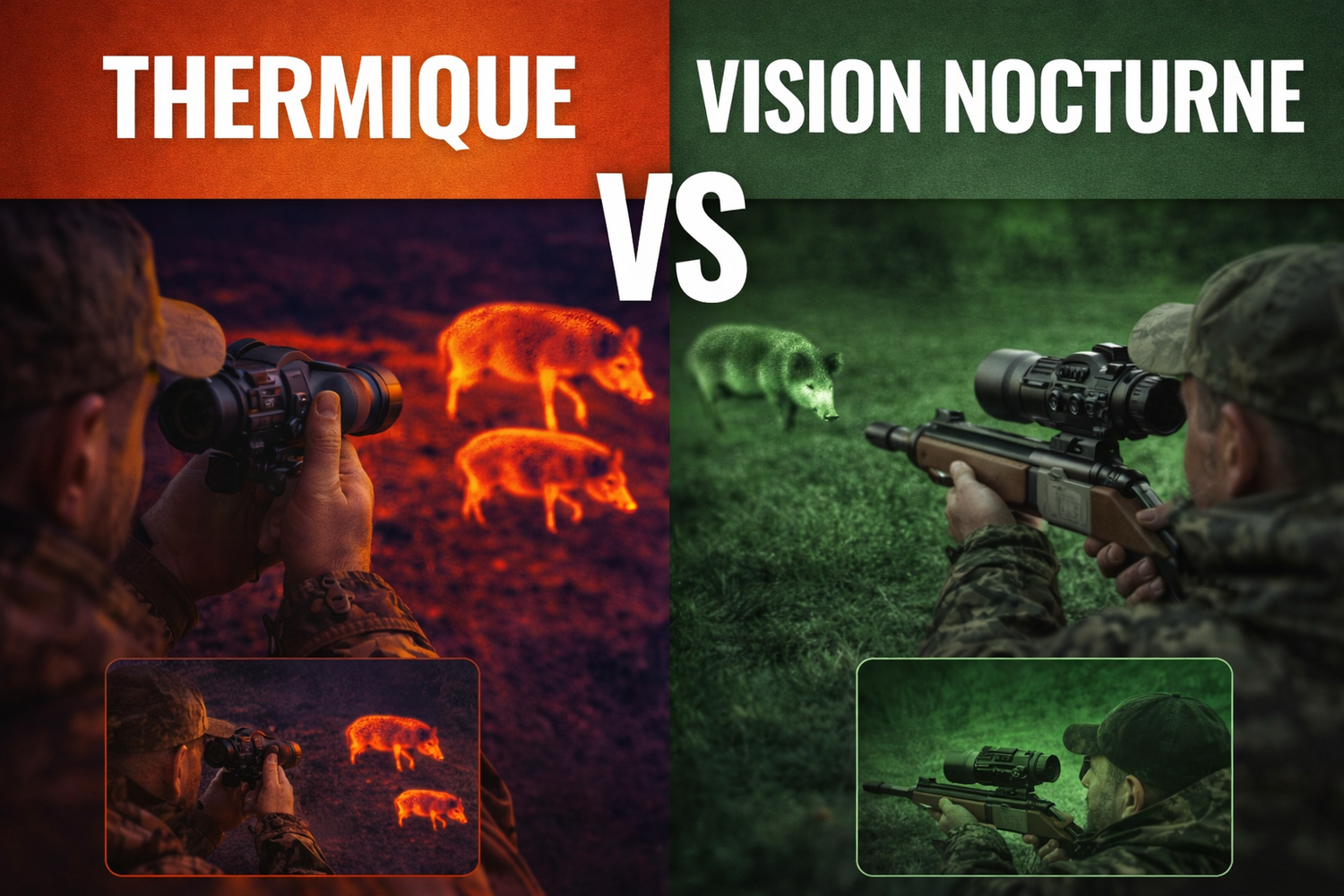
As hunting optics have evolved, two technologies have come to dominate the market: digital night vision and thermal imaging. They work differently and suit different uses.
So, which should you choose?
Night vision: a more natural view after dark
Night vision amplifies ambient light from the moon or stars, or uses an infrared illuminator. It produces an image close to normal vision, often in black and white or green.
Advantages
- A natural-looking, detailed image;
- Precise animal identification;
- Generally more affordable;
- Ideal at short and medium distances.
Drawbacks
- Requires some light or IR illumination;
- Less effective in fog or tall grass;
- More limited detection range than thermal imaging.
Thermal imaging: detecting heat
Thermal imaging does not depend on light. It detects temperature differences between living beings and their surroundings. An animal appears as a heat source even in complete darkness.
Advantages
- Works by day and night;
- Very fast animal detection;
- Effective where vegetation does not fully conceal the subject and in suitable fog conditions;
- Very long detection range.
Drawbacks
- Less detail for identification;
- A higher price;
- Less precise for distinguishing certain features.
Quick comparison: thermal imaging and night vision
| Criterion | Night vision | Thermal imaging |
|---|---|---|
| Operating principle | Light amplification | Heat detection |
| Use | Night only | Day and night |
| Animal detection | Moderate | Excellent |
| Precise identification | Very good | Moderate |
| Price | More affordable | Higher |
| Effectiveness in fog | Moderate | Very good |
Which type of hunting does each suit?
Night vision is recommended for:
- Short- and medium-distance hunting;
- Open surroundings;
- A limited budget;
- Precise identification of an animal.
Thermal imaging is recommended for:
- Long-range animal detection;
- Searching among vegetation;
- Hunting in difficult conditions.
Conclusion: complementary technologies
Night vision and thermal imaging address different needs. Night vision is ideal for precise identification; thermal imaging excels at detecting the presence of game.
The right choice depends on your budget, shooting distances and type of hunting.


Leave a comment
All comments are moderated before being published.
This site is protected by hCaptcha and the hCaptcha Privacy Policy and Terms of Service apply.