


Laser rangefinders, or LRFs, are increasingly common in scopes, binoculars and thermal or night vision systems. Yet many hunters still wonder whether they are useful or simply another gadget.
A laser rangefinder does not help you see better: it helps you make safer hunting decisions.
This article explains what an LRF does, when it becomes particularly valuable and its practical benefits in the field.
1. What is a laser rangefinder (LRF)?
An LRF measures the distance between the user and a target accurately.
How does it work?
- The LRF emits a laser pulse.
- The pulse reaches the target.
- The signal returns to the device.
- The system calculates the distance in real time.
The result appears immediately, usually in metres.
2. Why visual estimates are often wrong
Estimating distance while hunting is more difficult than it seems, especially at night, in open terrain, without visual reference points or when using optical or digital zoom.
Zoom compresses the apparent distance: a subject at 250 m can look as though it is 120 m away.
This can lead to misjudgements, shots falling short or travelling too far, and ethical and safety risks.
3. At what distance is an LRF useful?
- Below 80 m: a visual estimate is often sufficient.
- 80–150 m: the risk of an estimation error increases, and an LRF already offers a real benefit.
- Beyond 150 m: an LRF is strongly recommended.
The greater the distance, the larger an estimation error can become.
4. LRF and shooting safety
The LRF’s primary role is safety rather than performance. An accurate distance helps a hunter confirm that the subject is within a manageable range, make an informed decision, avoid a marginal shot and refrain from shooting when conditions are unsuitable.
👉 An LRF helps you decide when not to shoot as well as when to shoot.
5. LRF and ballistic accuracy
At medium and long distances, the bullet’s trajectory depends directly on distance. An error of 30 or 40 metres can mean a bullet arriving too low or too high, or a non-fatal hit.
An LRF provides an accurate distance, supporting better control and precision. This is particularly valuable for stalking, hunting on open ground and distances beyond 120–150 m.
6. LRF with thermal imaging and night vision
Thermal imaging and night vision provide fewer visual reference points. Without an LRF, distance is harder to estimate and the risk of error rises.
An integrated LRF combines thermal detection, night vision identification and precise distance measurement. This helps explain the growth of 2-in-1, 3-in-1 and 4-in-1 systems.
7. Advertised range versus practical range
Manufacturers often advertise 1,000 m, 1,500 m or 2,000 m. In hunting conditions, reliable measurement on an animal is more typically between 400 and 1,000 m, depending on its size, vegetation and weather.
⚠️ Maximum range figures are measured using reflective targets, such as buildings or signs.
8. Essential or optional?
Particularly valuable for
- Stalking;
- Distances beyond 120–150 m;
- Night hunting with thermal or night vision equipment;
- Open terrain, such as fields and crops.
More optional for
- Driven hunts;
- Very short, known distances;
- Very enclosed surroundings.
In other situations, an LRF adds convenience, safety and precision.
Conclusion
A laser rangefinder is more than a gadget. It provides accurate distance measurement, improves safety, supports more responsible decision-making and increases precision, especially at distance.
👉 Whenever distance becomes difficult to judge, an LRF becomes a valuable tool for the modern hunter.
🔎 Further reading
- Thermal imaging or night vision: which technology should you choose?
- Why 3-in-1 and 4-in-1 systems replace several devices
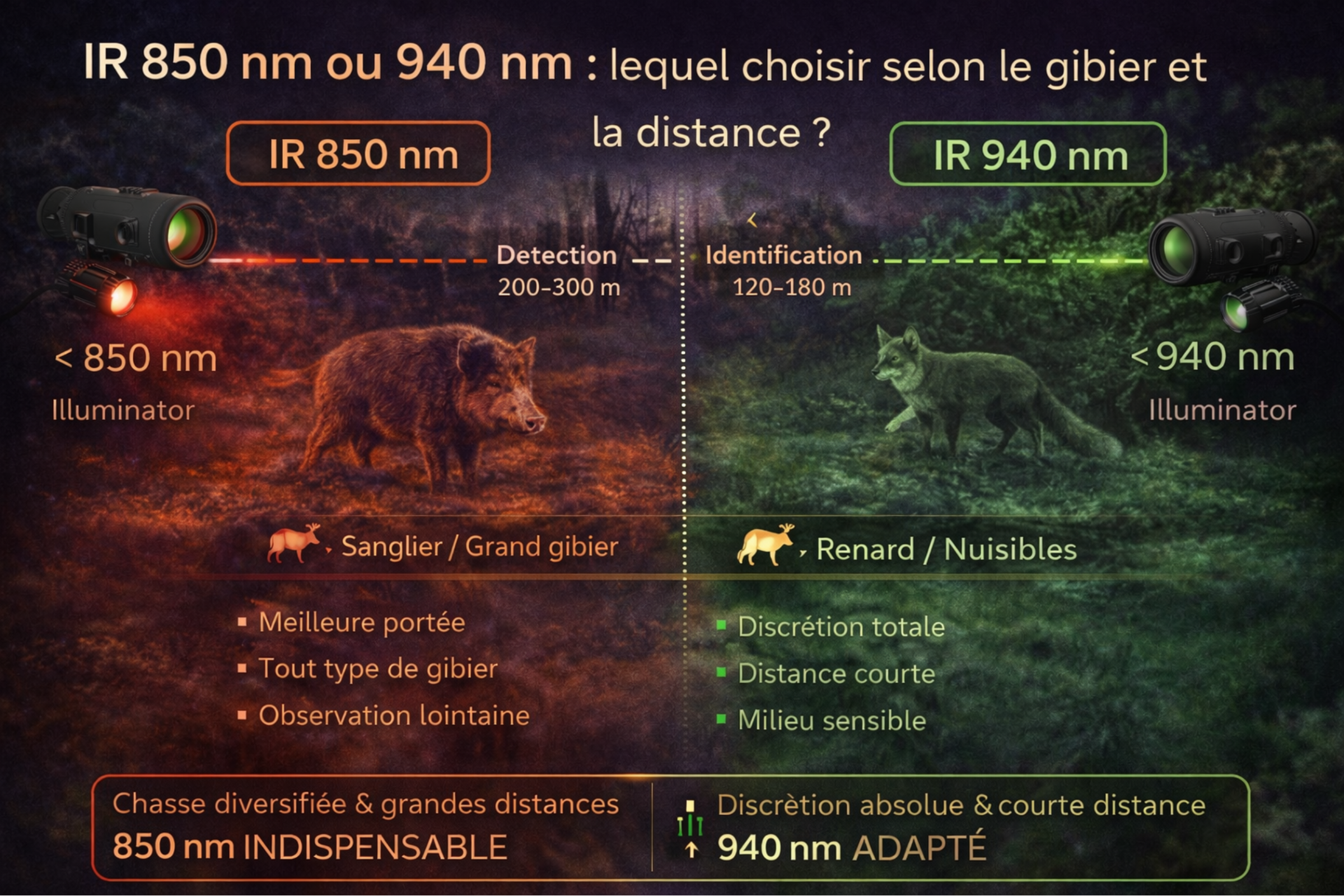
- 850 nm or 940 nm IR: which suits the game you hunt?

Leave a comment
All comments are moderated before being published.
This site is protected by hCaptcha and the hCaptcha Privacy Policy and Terms of Service apply.