

In digital night vision, choosing an infrared illuminator is about more than staying discreet. It directly affects practical observation range, the ability to identify game and performance in the field.
Contrary to a common claim, 940 nm is not inherently better than 850 nm. It is different and suits different uses.
1. What hunters need to understand
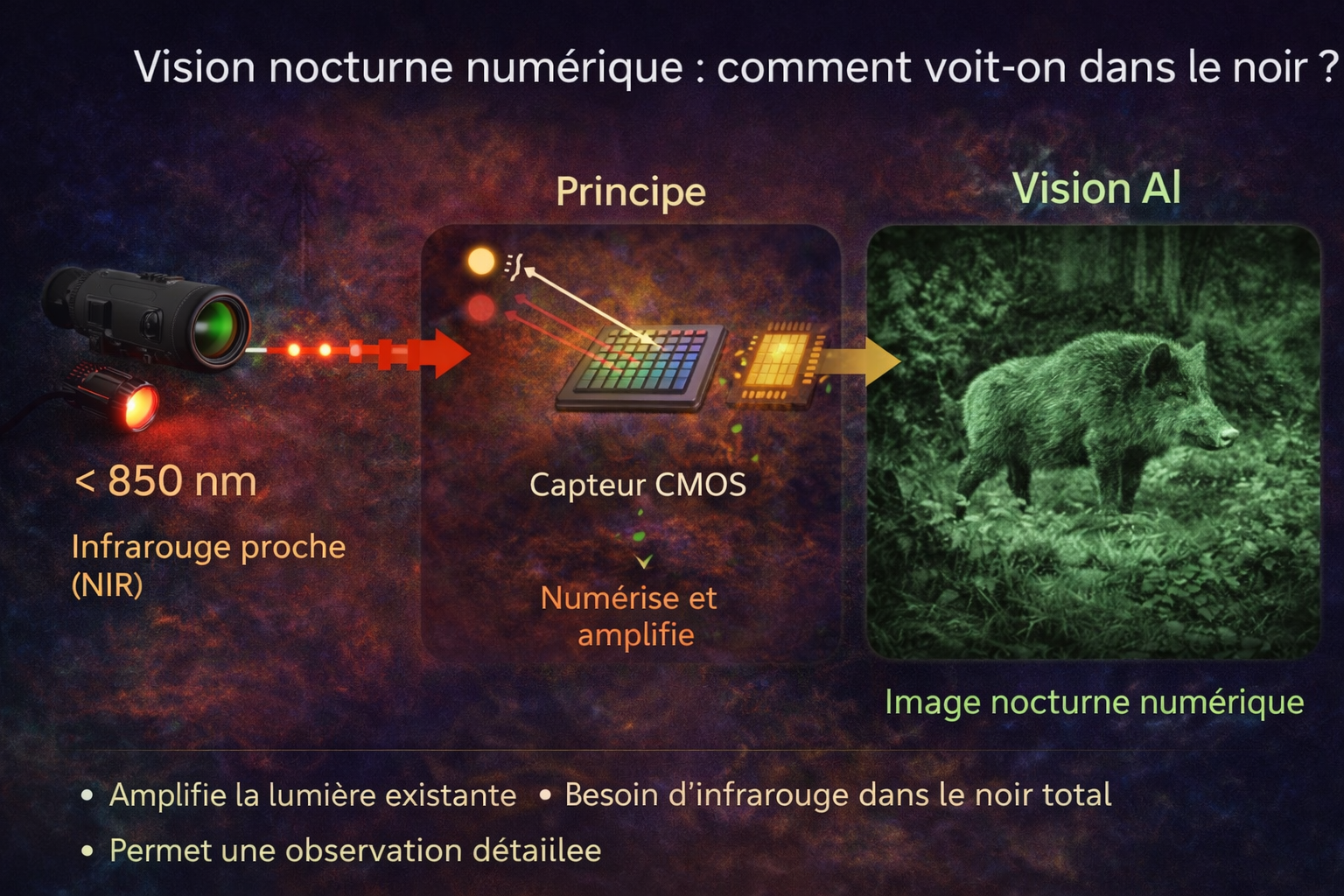
In night vision, the IR illuminator lights the scene and the sensor sees what it illuminates. The farther the illumination reaches, the farther you can see.
The chosen wavelength directly affects usable range, image brightness and the ability to identify game.
2. 850 nm IR: the most versatile option for hunting
850 nm IR is widely used by hunters because it provides brighter illumination over longer distances.
🔍 Practical ranges in the field
- Detection: 200–300 m;
- Usable identification: 120–180 m;
- Actual results depend on IR output and sensor quality.
🎯 Suitable game
- Wild boar;
- Roe deer;
- Foxes;
- Other deer species;
- Medium to large game.
The extra brightness helps distinguish silhouettes and posture and makes observation more reliable.
⚠️ Is the visible glow a concern?
The glow is visible only at the source. Beyond 30–40 m it becomes almost imperceptible. Game animals are observing the scene rather than staring at the LED.
In practice, a correctly used 850 nm illuminator need not alarm game.
3. 940 nm IR: short range and discretion
940 nm IR is invisible to the human eye but offers less range.
🔍 Practical ranges in the field
- Detection: 100–150 m;
- Usable identification: 50–90 m.
🎯 Suitable uses
- Small game;
- Foxes at short range;
- Pest species;
- Close observation.
940 nm makes sense when the distance is known, visual discretion is the priority and the surroundings are enclosed, such as a woodland edge or dense woodland.
4. A hunter’s comparison: practical ranges and uses
| Criterion | 850 nm IR | 940 nm IR |
|---|---|---|
| Realistic maximum range | 250–300 m | 120–150 m |
| Reliable identification | 120–180 m | 50–90 m |
| Image brightness | High | Medium |
| LED discretion | Medium | Complete |
| Medium/large game | ⭐⭐⭐⭐⭐ | ⭐⭐ |
| Small game/pest species | ⭐⭐⭐⭐ | ⭐⭐⭐⭐ |
| Versatility | ⭐⭐⭐⭐⭐ | ⭐⭐ |
5. Which IR wavelength suits your hunting?
🐗 Wild boar and large game
850 nm is the recommended choice for range, reliable identification and a clearer view of movement.
🦊 Foxes and pest species
Choose 850 nm for variable distances, or 940 nm for observation or shooting at a known short distance.
🌲 Dense woodland and short distances
940 nm is an option when maximum discretion matters and the surroundings limit the viewing distance.
🌾 Open ground and longer distances
850 nm is the key choice: 940 nm quickly reaches its limits.
6. What specifications do not always tell you
- A 940 nm illuminator often needs more power.
- More power means higher energy consumption.
- A poor 940 nm illuminator can produce a flat, dark image.
The final result also depends on the night vision sensor, optics and IR beam adjustment.
👉 A good, well-adjusted 850 nm illuminator will almost always outperform a standard 940 nm unit.
Conclusion
Choose between 850 nm and 940 nm according to the game, actual observation distance, woodland or open-ground environment, and the level of discretion required.
- 850 nm: range, identification and versatility.
- 940 nm: discretion and short distances.
For most hunters, 850 nm remains the strongest all-round choice.
🔎 Further reading
- Digital night vision: how do we see in the dark?
- Thermal imaging or night vision: which technology should you choose?
- Why hybrid systems appeal to hunters

Leave a comment
All comments are moderated before being published.
This site is protected by hCaptcha and the hCaptcha Privacy Policy and Terms of Service apply.