


Night vision is often described as technology that can “see in the dark”. In reality, it works very differently from thermal imaging and depends on something else entirely: light.
This article explains how digital night vision works, what it actually detects, why it needs infrared illumination and when it is most effective.
1. Night vision is not thermal imaging
This is the most common misunderstanding. Night vision does not detect heat: it captures and amplifies available light.
Even in surroundings that appear completely dark to the human eye, there is almost always faint moonlight, starlight or residual reflected light. Night vision uses and strengthens this light.
2. How digital night vision works
Digital night vision uses an electronic sensor, usually CMOS, similar to the sensor in a conventional camera.
What the sensor does
- Captures visible light;
- Also captures part of the near-infrared spectrum;
- Digitally amplifies the signal;
- Displays a usable image on a screen.
👉 The more light available, even faint light, the better the image.
3. Near-infrared (NIR): essential at night
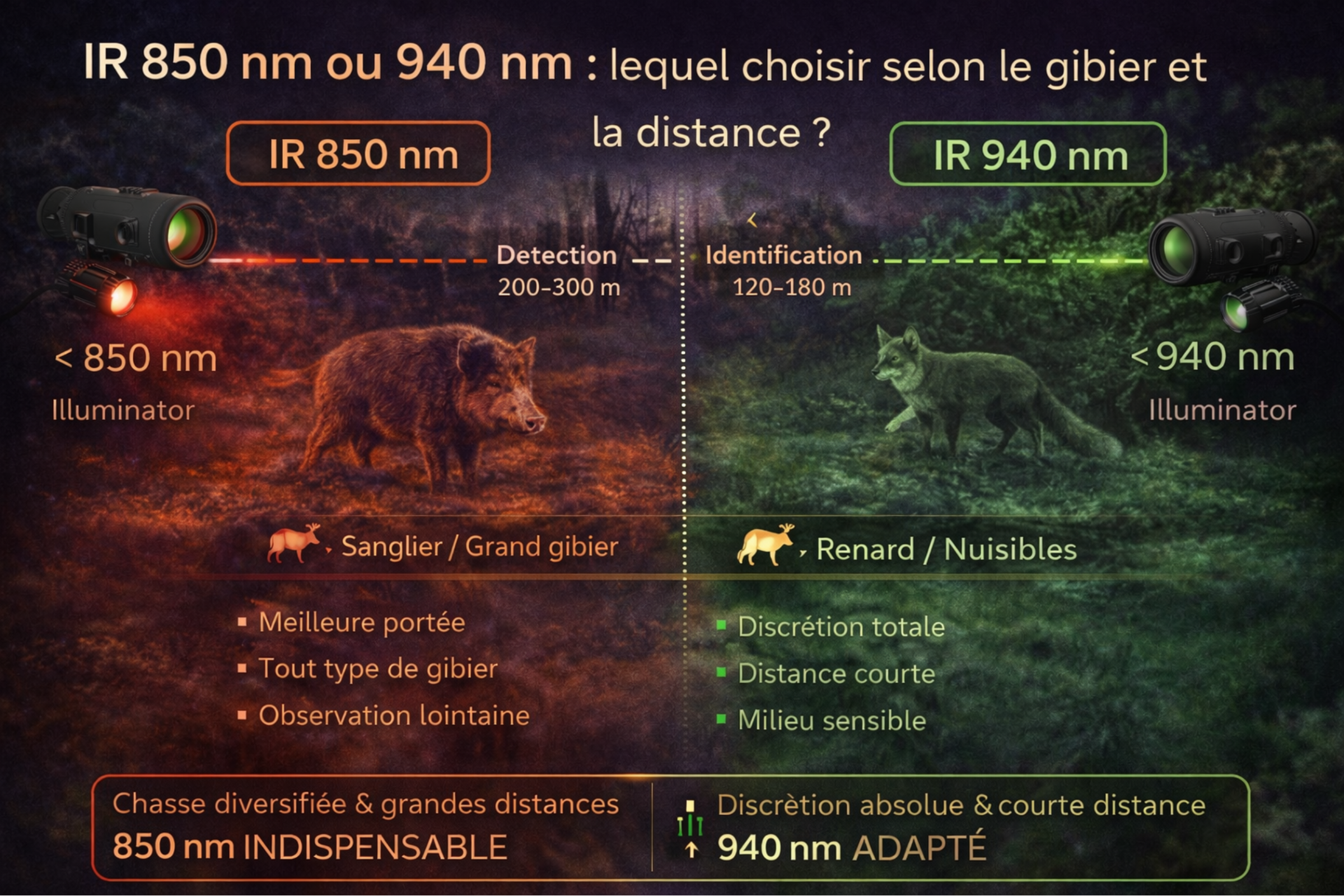
When natural light becomes insufficient, night vision uses an infrared illuminator. It emits light that the sensor can detect even though the illumination is invisible to the human eye.
Two main wavelengths
- 850 nm: longer range, with a faint red glow visible at the source.
- 940 nm: invisible illumination, with a shorter range.
👉 The illuminator lights the scene like an invisible torch; it does not reveal the subject by detecting heat.
4. Why night vision gives a more realistic image
Unlike thermal imaging, night vision provides an image with structure and detail that looks closer to normal vision.
It lets you identify a species, distinguish posture, recognise features in the surroundings and observe fine details such as antlers, silhouettes and environmental features.
👉 It is a reference technology for identification.
5. The limitations of digital night vision
Night vision is not suitable for every situation. Its main limitations are:
- Dependence on natural light or IR illumination;
- Reduced effectiveness in fog, rain or dense vegetation;
- Shorter detection range than thermal imaging;
- Quality that varies considerably with the sensor and illuminator.
👉 In complete darkness without IR illumination, night vision cannot produce a view.
6. 1080p or 4K night vision: what does resolution change?
As with thermal imaging, resolution is often highlighted. In practice, 1080p is more than sufficient for most uses.
4K offers a real benefit for identification at a distance, detailed observation and high-quality video recording.
👉 4K is a useful advantage, provided the sensor and IR illumination can support it.
7. When is night vision the best option?
Night vision is particularly effective for precise identification, at medium distances, in open surroundings and when thermal interference is high, such as in summer or over warm ground.
👉 It complements thermal imaging very well without replacing it.
Conclusion
Digital night vision lets you see in darkness by using natural or infrared light. It does not detect heat, provides a realistic and detailed image, and is ideal for identifying a subject.
It complements thermal imaging rather than being a direct substitute.
🔎 Further reading
- 850 nm or 940 nm IR: which should you choose?
- Thermal imaging or night vision: which technology suits your use?
- Why hybrid systems are becoming more common

Leave a comment
All comments are moderated before being published.
This site is protected by hCaptcha and the hCaptcha Privacy Policy and Terms of Service apply.