

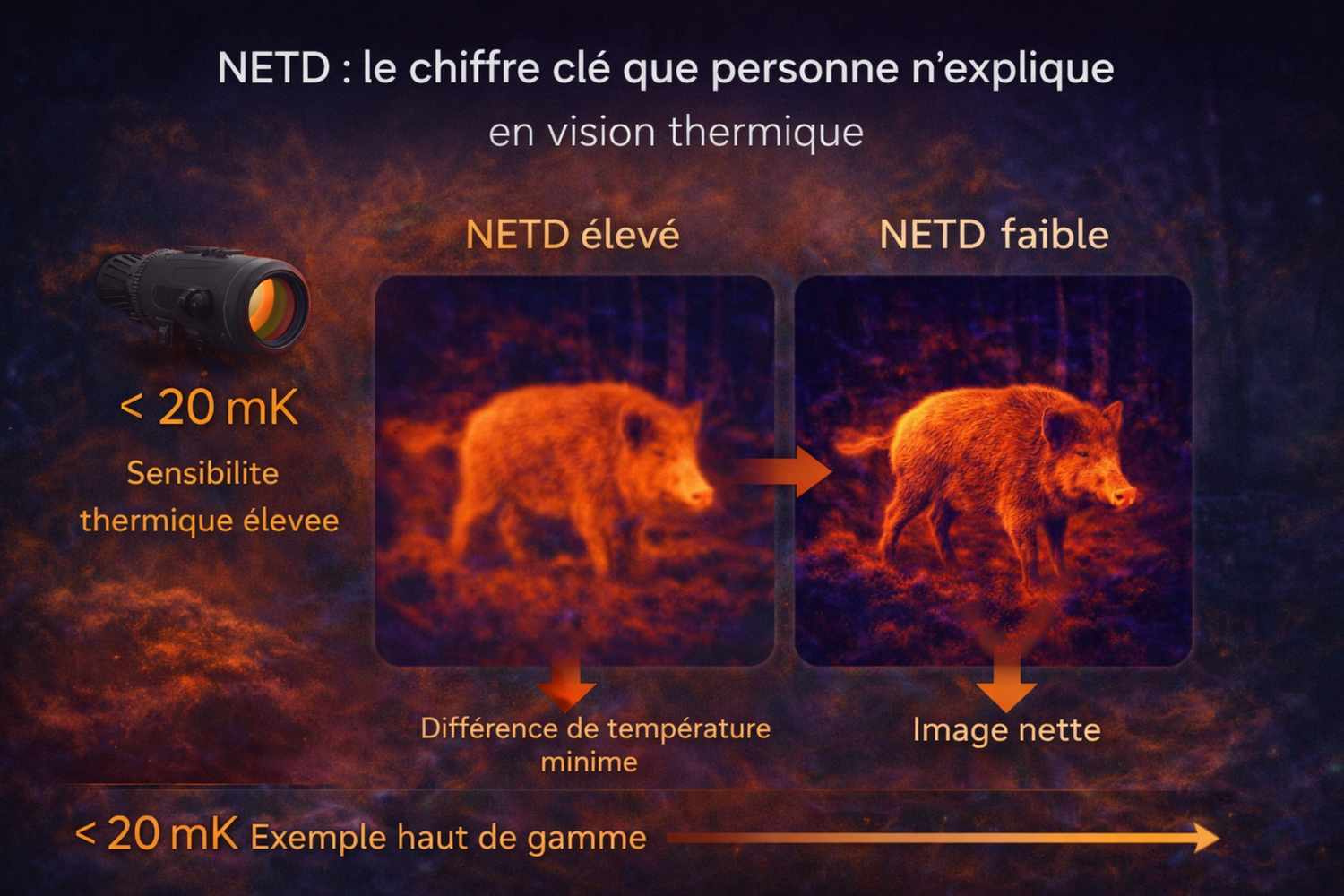
NETD: the key thermal imaging figure explained
When comparing thermal devices, one figure increasingly appears in the specifications: NETD. Usually expressed in millikelvins (mK) and sometimes promoted as a marketing argument, it remains one of the least understood criteria.
This article explains what NETD really means, why it can matter more than resolution and how to interpret it in the field.
1. What does NETD mean?
NETD stands for Noise Equivalent Temperature Difference. In simple terms, it is the smallest temperature difference a sensor can detect.
It indicates thermal sensitivity: the lower the NETD, the better the sensor can distinguish small temperature differences.
2. NETD explained simply
Imagine an animal and its surroundings at almost the same temperature. When the difference is very small, only a highly sensitive sensor can make the silhouette stand out. NETD measures this ability.
- High NETD: an image with less contrast.
- Low NETD: a clearer image that is easier to interpret.
3. How to read NETD values
NETD is expressed in millikelvins (mK). Useful reference points are:
- Below 50 mK: basic;
- Below 40 mK: adequate;
- Below 25 mK: very good;
- Below 20 mK: excellent;
- Below 15 mK: premium or professional.
👉 In practice, the difference between 40 mK and 20 mK can be very noticeable in the field.
4. Why NETD matters in difficult conditions
NETD becomes particularly important when thermal contrast is low, for example over warm ground in summer, in humid weather, in rain or fog, or at dawn and dusk.
In these situations, a less sensitive sensor smooths away detail, while a low-NETD sensor brings it out.
👉 This is where two thermal devices with the same resolution can perform very differently.
5. NETD or resolution: which matters more?
Good sensitivity is often more useful than very high resolution.
For example, compare a 384 × 288 sensor with NETD below 20 mK and a 640 × 512 sensor with NETD above 40 mK. In difficult conditions, the 384 sensor can provide a more usable image.
Resolution determines how much information the image contains; NETD influences the quality of that information.
6. Be cautious about marketing figures
Not all NETD specifications are directly comparable. Look out for:
- Measurements taken under ideal laboratory conditions;
- No reference temperature being stated;
- A claimed value without a tolerance.
👉 Two devices advertised as below 25 mK can behave very differently in the field. Always consider NETD alongside optical quality, software processing and practical experience.
7. When does NETD make a real difference?
- Occasional use: below 40 mK is sufficient.
- Regular use in varied conditions: below 25 mK is recommended.
- Intensive use in difficult conditions: below 20 mK is strongly recommended.
Below 20 mK, the improvement is perceptible, especially to experienced users.
Conclusion
NETD is one of the most important thermal imaging criteria, yet one of the least explained. It influences image detail, makes a difference in difficult conditions and can matter more than resolution alone.
👉 Understanding NETD helps you choose according to real use rather than marketing.
🔎 Further reading
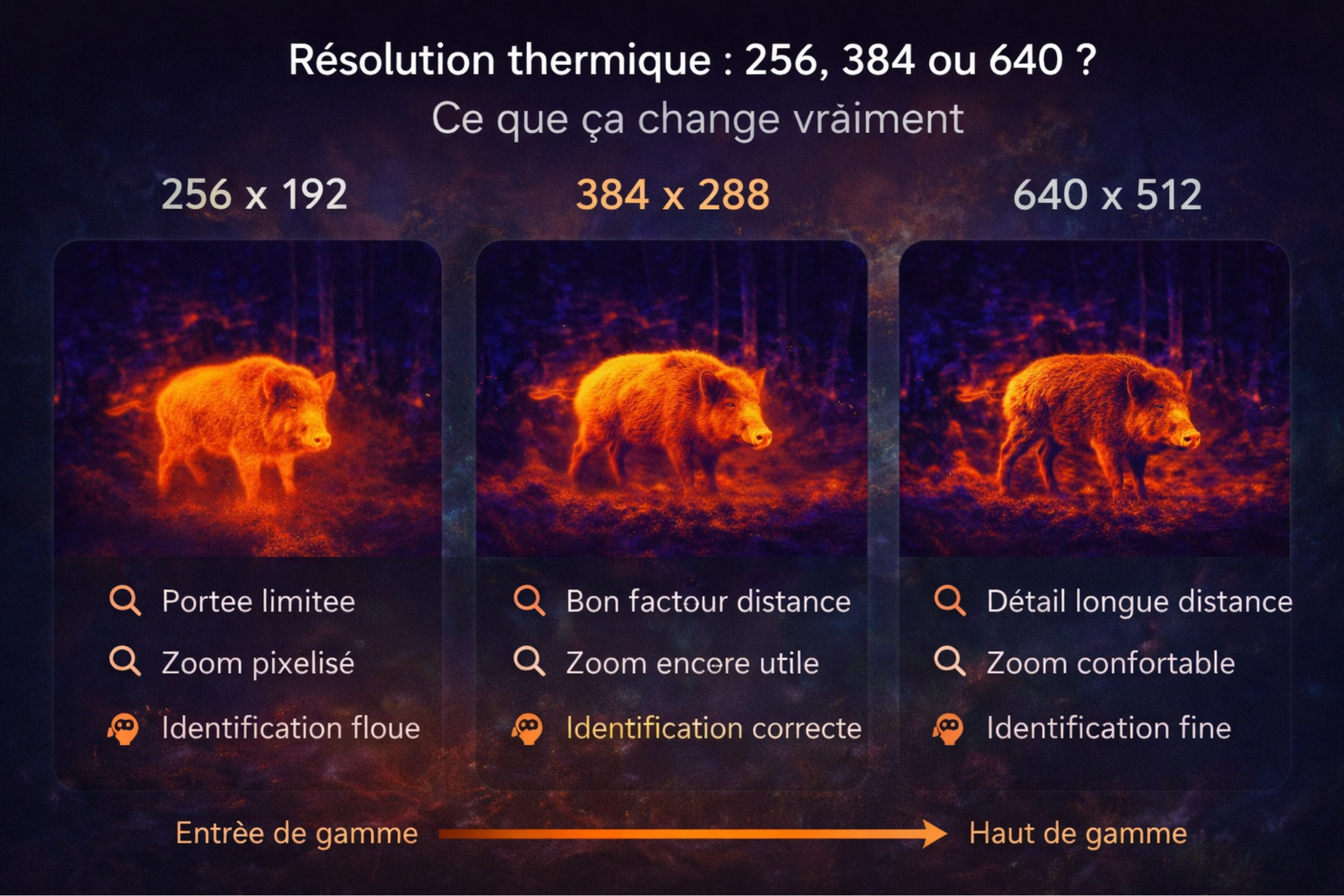
- Thermal resolution: 256, 384 or 640?
- Thermal sensors: how heat-based vision works
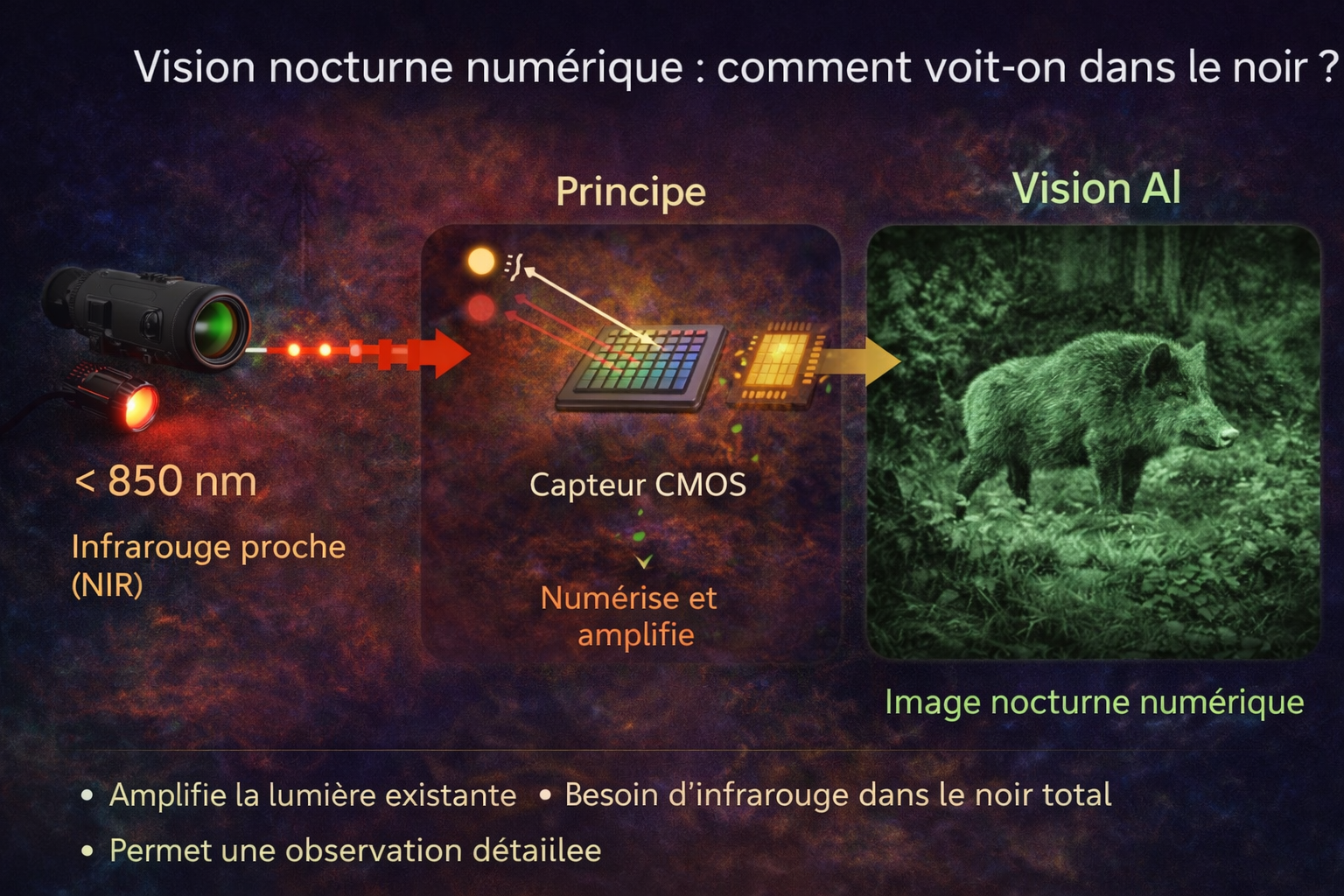
- Thermal imaging or night vision: which technology should you choose?

Leave a comment
All comments are moderated before being published.
This site is protected by hCaptcha and the hCaptcha Privacy Policy and Terms of Service apply.